What a geogrid is and what it does
A geogrid is a flat, open mesh installed within or under a soil layer to carry tension. Compacted aggregate strikes into the apertures of the geogrid mesh and locks there, so the fill can no longer spread sideways under load — the layer behaves as a stiffer slab and spreads pressure over the weaker soil below. That is the whole product in one sentence: a geogrid reinforces. It does not separate soil layers (a geotextile does that), drain water (a geonet does), or confine loose stone at the surface (that is a cellular gravel grid, a different product buyers often mix up with this one).
Five geogrid types, sorted by the job
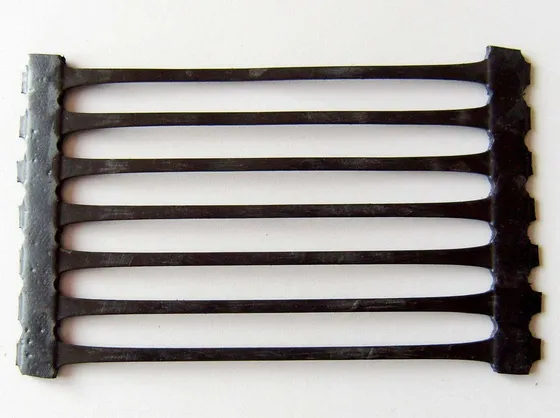
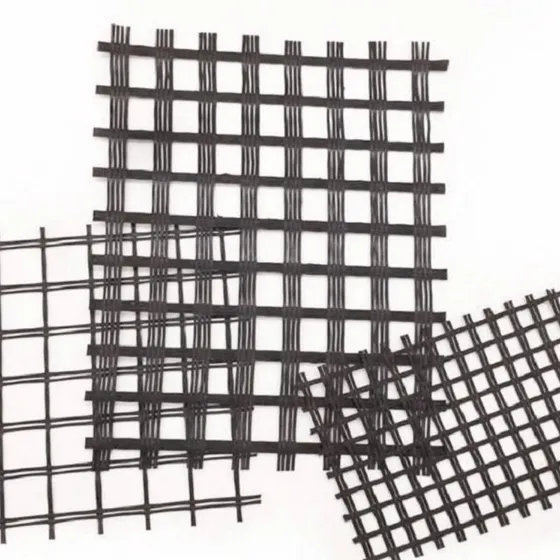
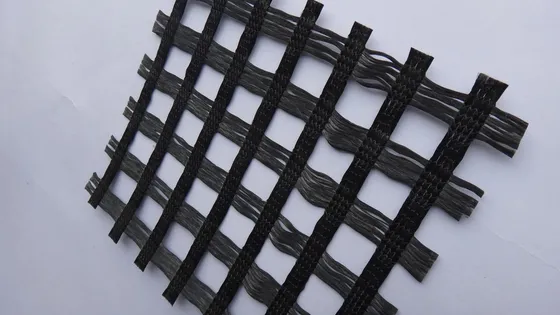
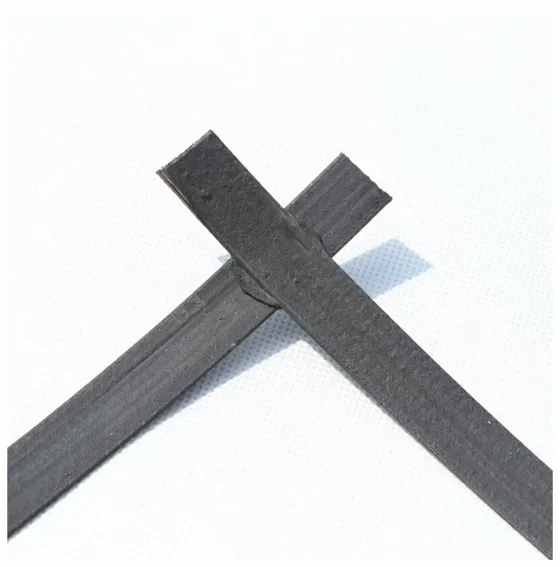
We supply five constructions. PP biaxial geogrid is punched and drawn in both directions, for subgrades and working platforms. Uniaxial geogrid is drawn one way, with its strength concentrated along the roll for walls and slopes. Fiberglass geogrid goes between asphalt layers to control reflective cracking. Polyester geogrid is a warp-knitted PET grid with published long-term design strength for reinforced-soil structures. Steel-plastic geogrid puts steel wire inside welded polyethylene straps for soft ground where settlement governs. A plastic geogrid — the PP and HDPE types — covers most soil reinforcement work; glass fibre and PET take over inside pavements and in structures designed for a century. The full sorting logic, type by type, is in geogrid types explained.
The five types compared
Figures are taken from the datasheets published on each product page; the full property tables and test methods are there.
| PP biaxial | Uniaxial (PP / HDPE) | Fiberglass | Polyester (PET) | Steel-plastic |
|---|
| Material | Polypropylene, punched and drawn both ways | PP or HDPE, drawn in the machine direction | Alkali-free glass fibre, bitumen coated | Warp-knitted PET yarn, PVC / SBR / bitumen coated | Steel wire core in a polyethylene sheath, welded junctions |
|---|
| Load direction | Both directions (MD = CD) | One direction (along the roll) | Both directions (warp = weft) | Uniaxial range; knitted biaxial grades available | Biaxial (GSZ) and uniaxial (GDZ) ranges |
|---|
| Typical use | Road subgrade, base courses, working platforms | Retaining walls, MSE walls, reinforced slopes | Asphalt overlays — reflective crack control | MSE walls, steep slopes, basal reinforcement | High fills on soft ground, bridge approaches, cold regions |
|---|
| Key figures | 15-15 to 50-50 kN/m; junction efficiency 93% | PP 60–300 kN/m, HDPE 60–200 kN/m; RF_cr 2.23 at a 114-year design life | 25–120 kN/m; elongation at break ≤ 4% | Ultimate 60–800 kN/m; LTDS 34–452 kN/m at a 120-year design life | Biaxial 30-30 to 120-120 kN/m; elongation ≤ 3%; frost resistance −35 °C |
|---|
Road subgrade and base stabilization
Most of what we export is geogrid for roads. A single biaxial layer at the subgrade interface raises bearing capacity, cuts rutting and lets a thinner base course do the same job: grades 15-15 and 20-20 suit light access roads and car parks, 30-30 is the common highway grade, and 40-40 to 50-50 go under heavy axle loads and container yards. As geogrid for road stabilization on high fills and bridge approaches, the steel-plastic composite earns its cost — it reaches useful tensile force at under 3% strain, before settlement shows at the surface. On soft or fine-grained ground, pair the grid with a separation fabric: woven geotextile below where the separator must carry load, nonwoven geotextile where filtration matters more. The mechanism, layer by layer, is in geogrid for road subgrade stabilization.
Retaining walls and slopes
A geogrid retaining wall resists earth pressure as a mass, not as a face: horizontal layers of grid tie the facing blocks to a much larger reinforced soil block behind them. The workhorse is uniaxial geogrid — PP to 300 kN/m, HDPE to 200 kN/m with a creep reduction factor of 2.23 published for a 114-year design life — while the warp-knitted polyester grades carry long-term design strengths from 34 to 452 kN/m at a 120-year design life for MSE walls and bridge abutments. The same uniaxial and PET grids let a reinforced slope stand steeper than its soil would allow unreinforced. Strength grade, layer spacing and embedment length come from the wall design, not from a catalogue; the sequence, and the mistakes that bring walls down, are in geogrid retaining wall design and installation.
How to specify and order
Send the design tensile strength (or the grade name), the total area and the destination port, and we return an ex-works, FOB or CIF price with a container loading plan — for standard grades, the same business day. If the specification only says "geogrid", start from the table above and the product page closest to your application, or send the drawings and we will propose a grade for your engineer to confirm. What actually drives the price per square metre — polymer, grade, roll size and how many square metres fit a container — is set out in the geogrid price guide.

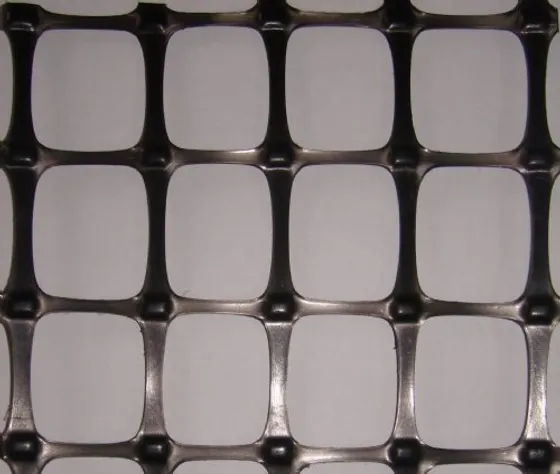 Geogrid