Why a road on soft ground needs reinforcement at all
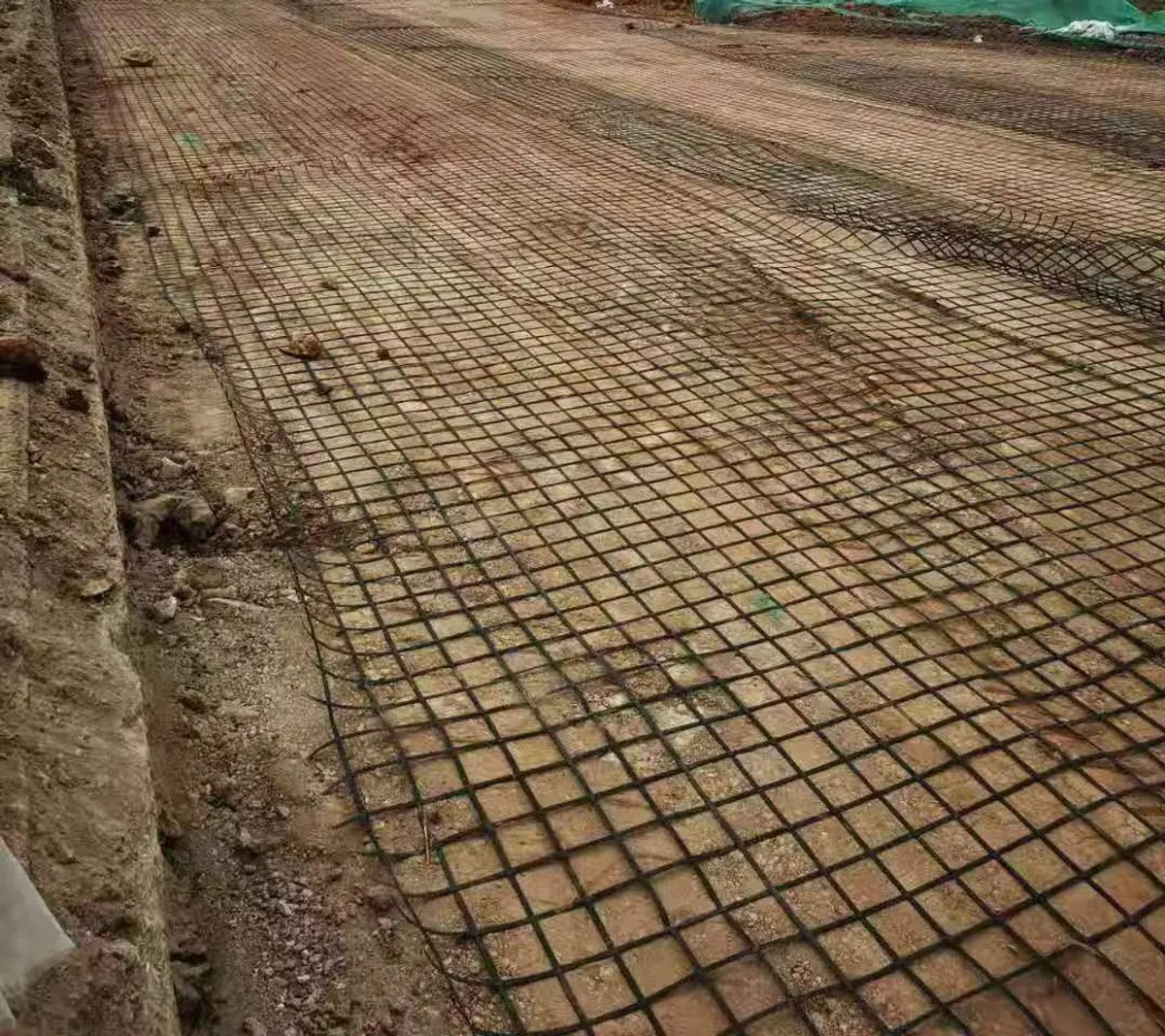
A granular base only works if the stone stays where you put it. Over a weak subgrade it does not: each wheel pass pushes aggregate sideways, the layer thins, the soft soil below squeezes up into it, and a rut forms that then collects water and accelerates everything. Geogrid subgrade stabilization attacks that one failure mode. Our base stabilization geogrids are laid at the subgrade interface to confine the fill so it cannot spread laterally, which raises the effective bearing capacity of the layer and holds the rut depth down over the service life rather than just at day one. The knock-on effect is the one that pays for the material: because the reinforced layer distributes pressure over a wider area of soft soil, most designs can carry the same traffic on a measurably thinner base course.
What the grid actually does under the base course
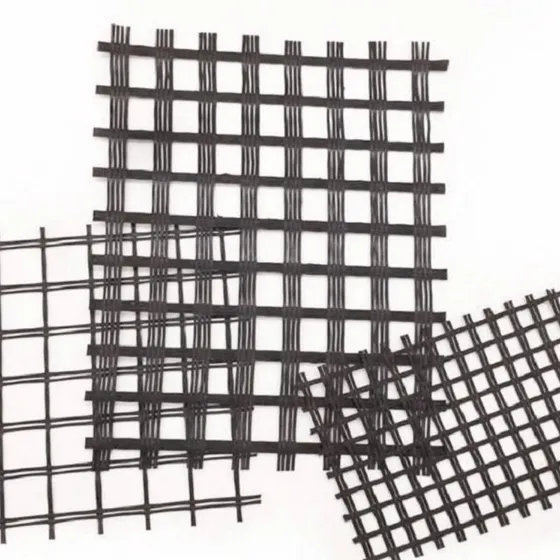
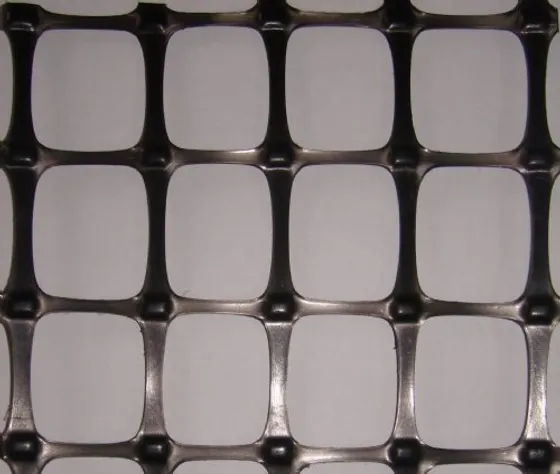
Place a PP biaxial geogrid on the prepared formation and end-dump aggregate over it, and stone particles drop into the square apertures and lock there. Once confined, the fill behaves more like a stiff slab than a loose pile. That interlock is the whole mechanism behind geogrid for road stabilization, and it is why aperture size has to suit the fill — coarse stone needs a bigger opening to seat in, which is why a large-aperture range exists alongside the standard one. Because a biaxial grid is drawn in both directions, it carries load along and across the roll, which is what you want under wheel loads that arrive from every direction: carriageways, yards, container hardstanding and working platforms all load the same layer in plan, not in a line.
Strain, not breaking strength, is the number to compare
Geogrid for road construction is routinely quoted on ultimate tensile strength, and that figure is close to useless for choosing between grades. A stabilization layer never approaches its break load — the subgrade would have failed long before. What matters is how much force the grid develops at the small strains a road actually experiences, so compare designs on tensile strength at 2% and 5% strain, which we publish for every grade of the biaxial range. As a working guide, the 15-15 and 20-20 grades suit light access roads and car parks, 30-30 is the common highway and yard grade, and 40-40 up to 50-50 goes under heavy axle loads, container handling and railway formation. The project engineer sets the grade against the actual subgrade CBR and design traffic.
When to step up to a steel-cored grid
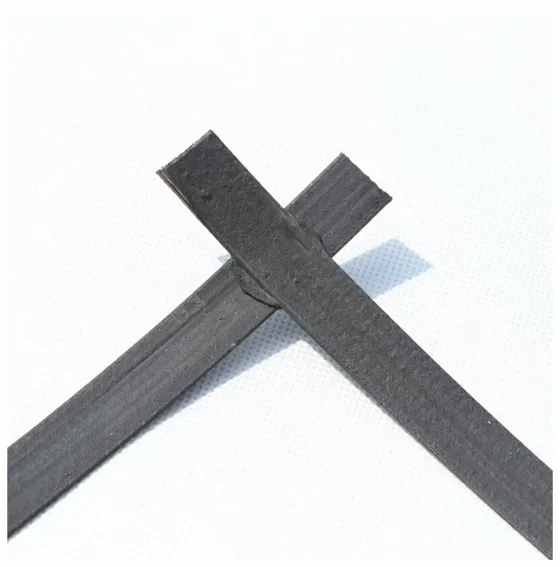
Extruded polymer grids have to strain before they take load, and on an ordinary base course that is fine. It stops being fine when settlement rather than rutting is the failure you are designing against — a high embankment on soft clay, a bridge approach, a culvert crossing, or the longitudinal joint where a widening meets the existing carriageway. There a few centimetres of differential movement cracks the pavement even though nothing has structurally failed. Steel-plastic geogrid breaks at no more than 3% elongation, so it develops useful tension while the fill is still going in rather than after the road has settled, and its published strength after 100 freeze-thaw cycles is unchanged from the original at every grade — the argument that usually decides cold-region work. It costs more than plastic, and it should only be specified where that low strain earns the difference.
Asphalt interlayers are a different product and a different problem
Geogrid in pavement means two entirely different things, and conflating them wastes money. Everything above concerns reinforcement below the pavement, in the base or at the subgrade, where the enemy is bearing capacity and rutting. A grid placed inside the asphalt — between the milled surface and a new overlay — is doing something else: intercepting the stress that drives a reflective crack up from an old joint or crack into the new layer. That job needs a very high modulus at very low strain and needs to survive hot-mix placement, which is why it is made of glass fibre rather than plastic. See fiberglass geogrid for that application. If your pavement is cracked but the formation is sound, a base-course grid will not help you, and vice versa.
Gravel roads and gravel driveways
Unpaved haul roads and gravel roads take the same treatment as a paved formation, usually with a lighter grade — the grid goes under the stone, confines it, and stops the surface course disappearing into the mud over a wet season. That is a real and common use of geogrid for gravel roads, and it is also what a reinforcing grid does beneath a gravel driveway: it sits under the base, out of sight. If what you actually want is the honeycomb panel that holds the surface gravel in place from above so it does not migrate and scatter, that is a different product entirely — go to gravel grid panels, or the deeper HDPE geocell where the cells have to confine fill under load. A flat mesh will not stop surface stone from wandering; a cellular panel will not reinforce a subgrade.
Specify the separation layer with it
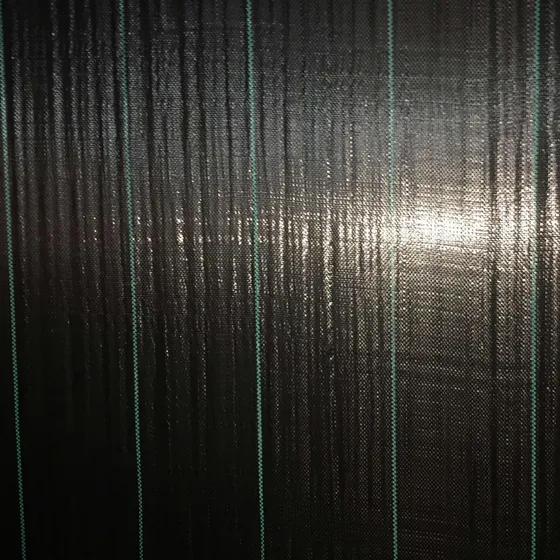
On soft, fine-grained or waterlogged subgrades the grid is only half the system. A grid reinforces; it does not separate. Without a fabric between the aggregate and the soil, fines pump up into the granular layer under repeated loading and the base loses the strength you just paid to add. Pair the grid with a woven geotextile where the separator should also carry some load, or a nonwoven geotextile where filtration and drainage matter more than tension. Send us the subgrade condition, design traffic and the area and we will quote the grid and the fabric together against your specification — the full range is on our products page.
Free Geosynthetics Spec & Selection Guide
Material grades, thickness/GSM sizing and price ranges for your project — sent to your inbox.

 Geogrid