One word, five very different products
A geogrid is an open polymer mesh buried in soil or asphalt whose apertures let fill pass through and lock in place, so the layer carries tension the soil cannot. That much is common to every product on this page. Everything else — polymer, aperture shape, how the junctions are made, how much the grid stretches before it takes load — changes with the type, and those differences decide whether a grid works or is simply an expensive layer of plastic in the ground. Two questions sort the field: which direction does the load pull, and what is the geogrid material.
Load direction: biaxial or uniaxial
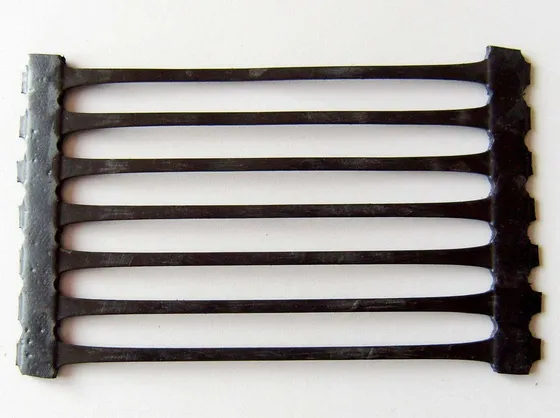
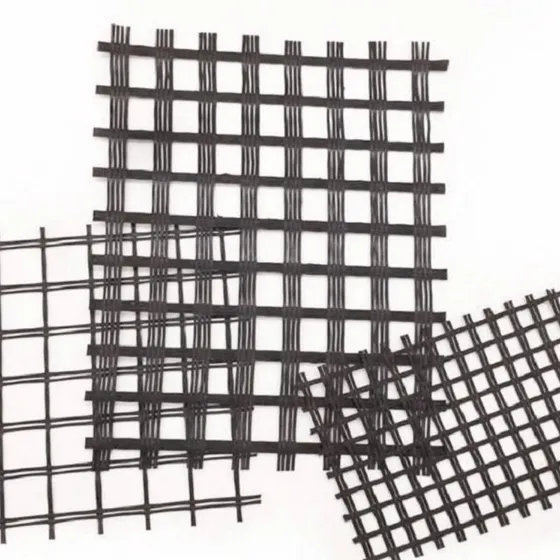
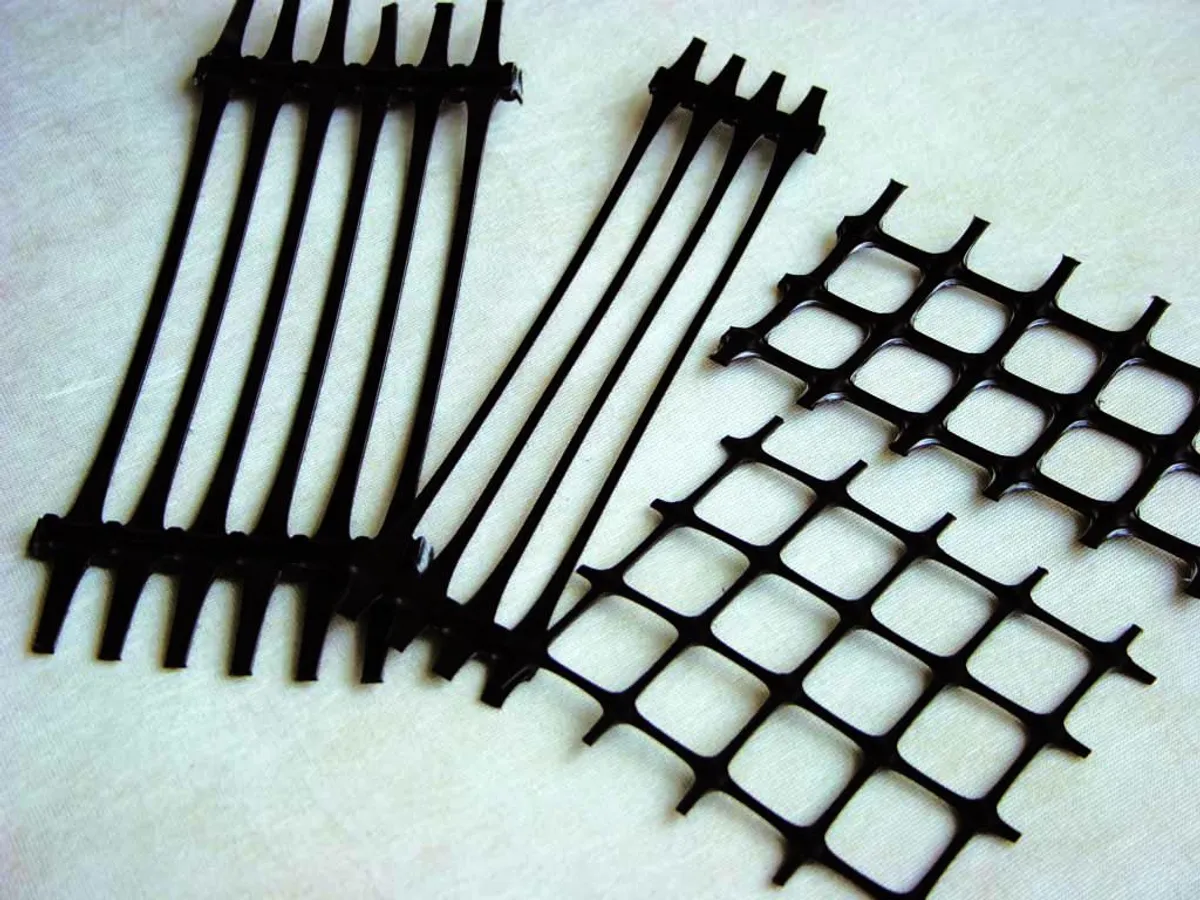
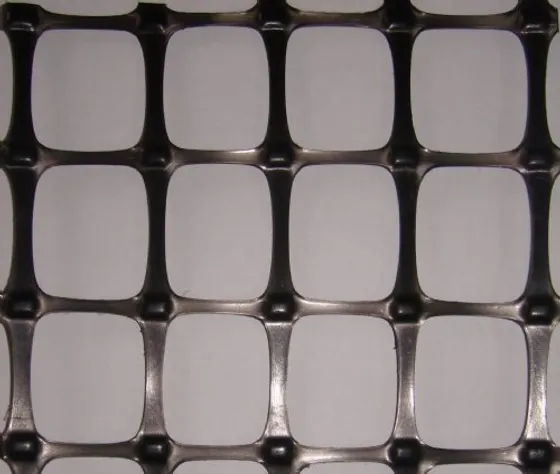
A biaxial geogrid is drawn in both the machine and cross directions, so it ends up with square apertures and roughly equal strength each way. That is what an area needs — a subgrade, a working platform, a haul road, a container yard — because wheel loads arrive from any bearing. A uniaxial geogrid is drawn one way only; the apertures stretch into long ovals and nearly all the strength concentrates along the roll. That matches a reinforced soil structure, where every layer pulls back from the face against the earth pressure behind it: retaining and MSE walls, steep reinforced slopes, bridge abutment fills. Getting this wrong is the most common specification error we see — a bidirectional grid laid into a wall wastes half its polymer in the direction nothing is pulling.
Geogrid material: what each polymer is for
- Polypropylene (PP) — punched and drawn sheet with integral junctions, the everyday plastic geogrid for base and subgrade work. Our biaxial range runs 15-15 to 50-50 kN/m at 93% junction efficiency.
- HDPE — punched from solid sheet and drawn uniaxially, 60 to 200 kN/m. Specified where a long design life must be demonstrated rather than assumed: the range publishes a creep reduction factor of 2.23 at a 114-year design life.
- Glass fibre — warp-knitted alkali-free roving with a modified bitumen coating. It is not a soil product at all; it lives between asphalt layers, where ≤ 4% elongation and tolerance of hot-mix temperature are what matter.
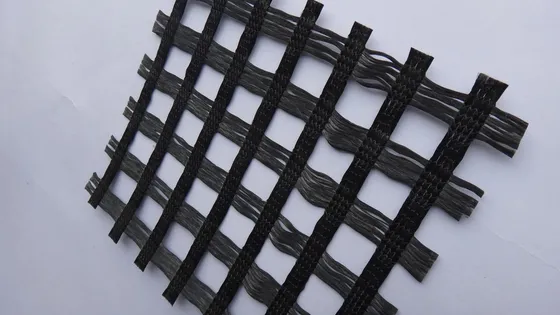
- Polyester (PET) — warp-knitted high-tenacity filament, coated in PVC, SBR or bitumen. Flexible, drapes onto a subgrade, and publishes long-term design strength from 34 to 452 kN/m at a 120-year design life.
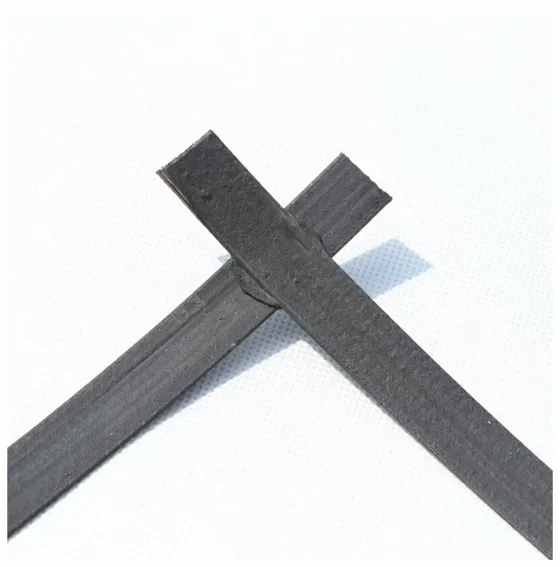
- Steel-plastic composite — steel wire in a polyethylene sheath, welded at every crossing, breaking at ≤ 3% elongation and holding full strength after 100 freeze-thaw cycles.
Selection shortcut
Working platform, haul road, yard or subgrade under a new road → PP biaxial geogrid, grade set by axle load: 15-15 and 20-20 for light access and car parks, 30-30 for highways and heavy yards, 40-40 and up for ports and railway formation. Retaining wall, MSE wall or steep slope → uniaxial geogrid at the grade the wall designer specifies, or polyester geogrid when the submittal wants long-term design strength against a stated design life. Asphalt overlay on a cracked but structurally sound pavement → fiberglass geogrid, never a plastic grid. High fill on soft ground, bridge approach, road widening or a cold-region corridor where settlement rather than collapse is the risk → steel-plastic geogrid, bought for its stiffness at low strain.
Stiffness beats breaking strength
Buyers compare grids on ultimate tensile strength because it is the biggest number on the datasheet. Designers rarely use it. A stabilization layer works at small strain — a road that has moved enough to break a grid has already failed as a road — so the honest comparison is tensile strength at 2% and 5% strain, which we publish for every grade, and for walls the long-term design strength after creep, installation damage and ageing. That is why a 60 kN/m PET grid and a 60 kN/m PP grid are not interchangeable, and why the steel composite earns its price on jobs where the reinforcement has to be working before the embankment settles.
Geogrid reinforced soil is a system, not a roll
On soft or fine-grained ground the grid is only half of it. A grid reinforces; it does not separate. Without a fabric below, fines pump up into the granular layer and the layer quietly loses the strength the design assumed. Pair the reinforcement with a woven geotextile where the separator must also carry load, or a nonwoven geotextile where filtration and drainage matter more, and add a geonet where water has to be led away in-plane. A note on vocabulary: what North American buyers call a "ground grid" for a gravel driveway is usually a cellular gravel grid panel, not the flat structural geogrid described here.
Getting the right type quoted
Tell us the application, the subgrade, the load and — if you have it — the design tensile strength or LTDS the engineer specified, and we will name the type and grade rather than selling you the one we happen to hold. We make the PP, HDPE and PET lines in-house and source the fiberglass and steel-plastic ranges from vetted mills, which we state on every offer. The full geosynthetics range shows the geotextiles and drainage materials that ship in the same container.
Free Geosynthetics Spec & Selection Guide
Material grades, thickness/GSM sizing and price ranges for your project — sent to your inbox.

 Geogrid