Polyester Geogrid

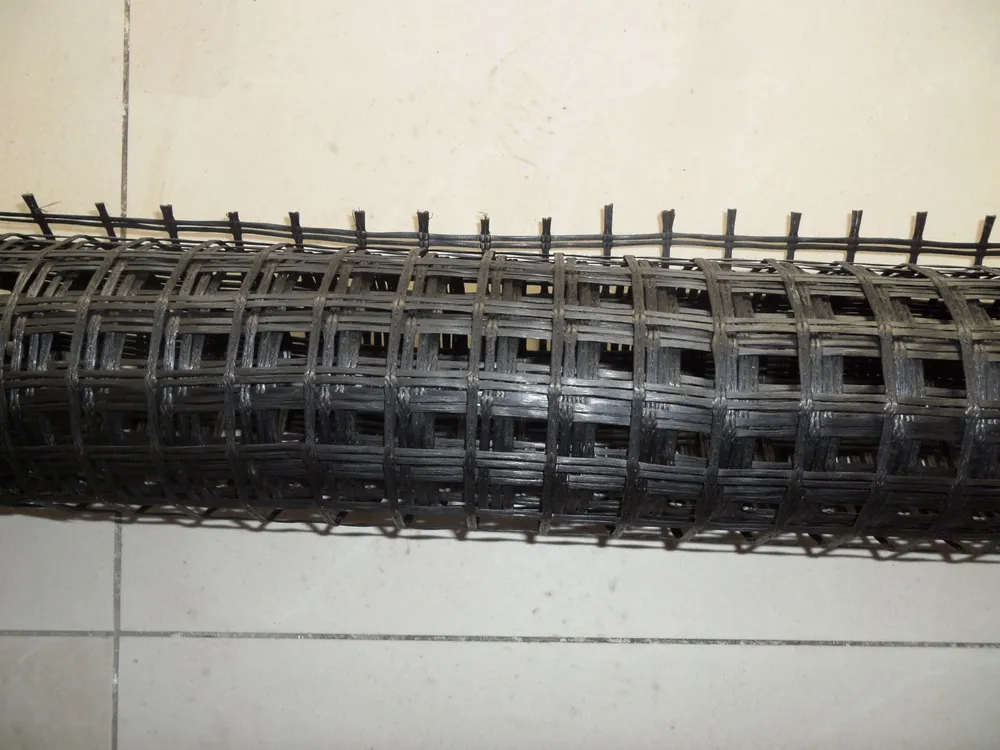
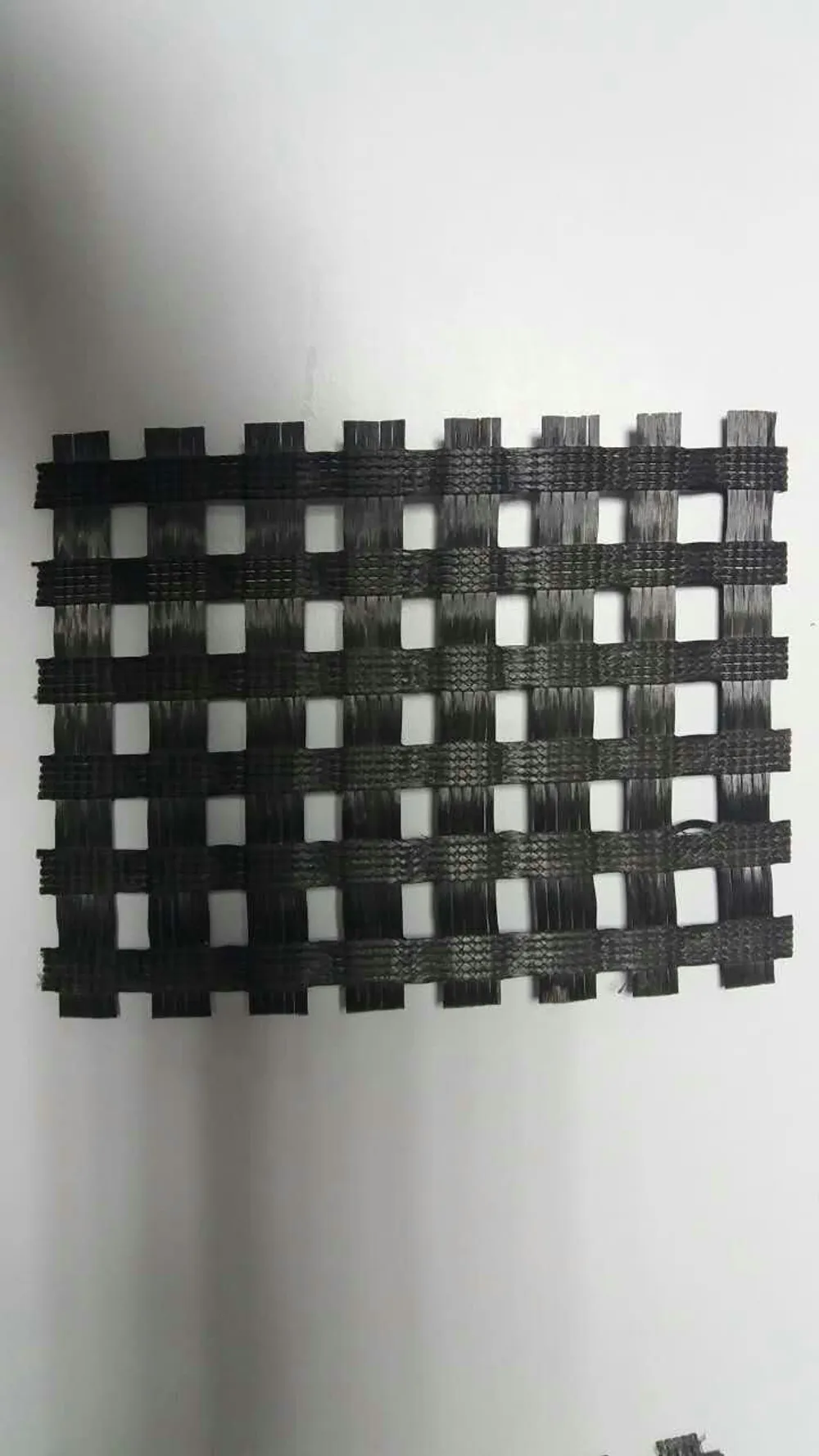
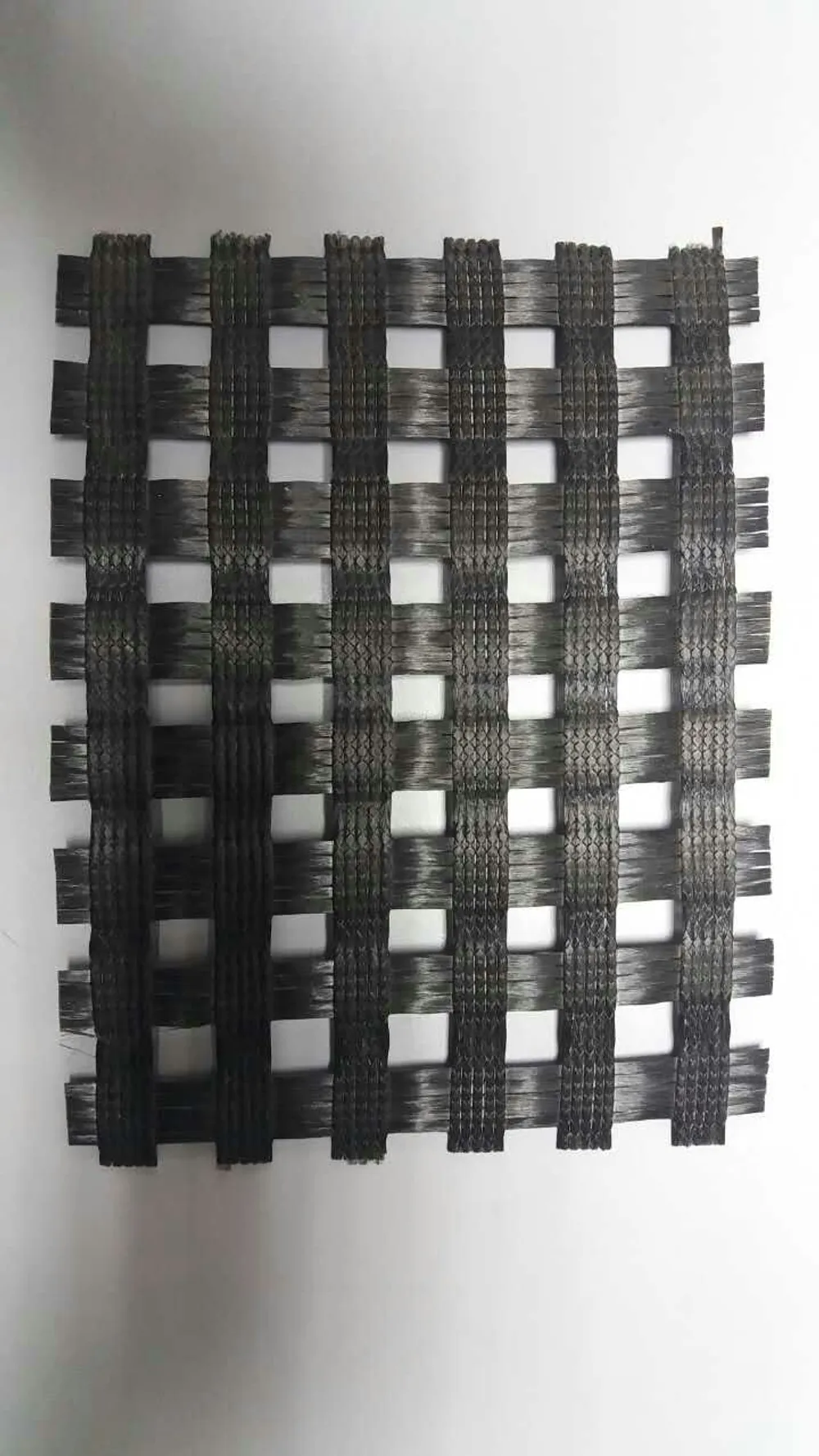
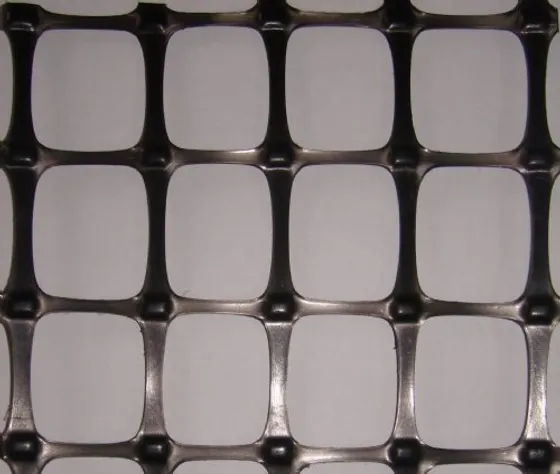
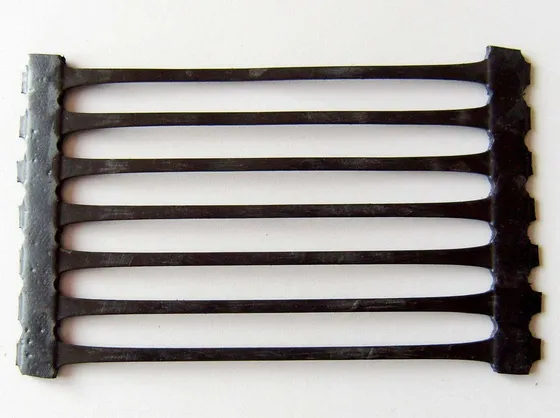
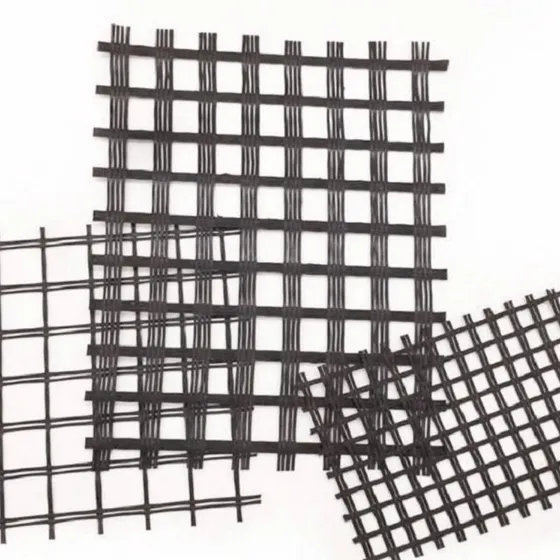
SIGMA polyester geogrid is warp-knitted from high-tenacity PET industrial filament, with the yarn bundles bound at every crossing point and the finished grid coated in PVC, SBR or bitumen. That construction makes it flexible, so it drapes onto a prepared subgrade instead of bridging over it, and it carries useful load at the small strains a structure actually works at — 30 kN/m at 5% strain on the 60 grade, 270 kN/m on the 800. The uniaxial PVC-coated range publishes long-term design strength (LTDS) for a 120-year design life, from 34 to 452 kN/m, which is the number a reinforced-soil wall is designed against. Knitted biaxial and low-strength uniaxial ladders are also produced, and grades above 800 kN/m are quoted per project.

LTDS 34–452 kN/m @ 120 yrWarp-knitted PETPVC / SBR / bitumen coated
Polyester Geogrid

What a warp-knitted PET geogrid is

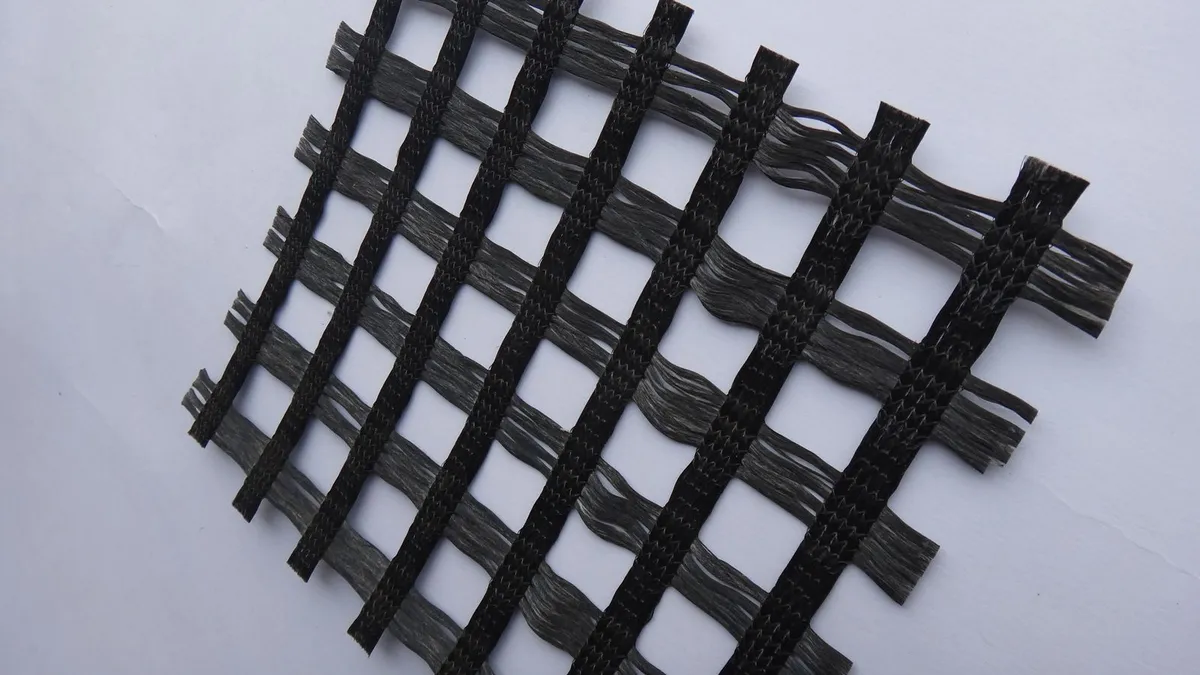
A polyester geogrid is built the way a textile is built: bundles of high-tenacity PET industrial filament are laid out as warp and weft, knitted together so the yarns are bound at every crossing, then coated. The load is carried by the straight, continuous filament bundles rather than by a stretched polymer sheet, which is why a PET grid reaches high strength without the thickness of an extruded rib. Because buyers often search for a woven geogrid or a pet geogrid and mean the same product, note the distinction: ours is warp-knitted with bound junctions, not a loose weave that can rack out of square during placement.

Long-term design strength is the number that matters

For a geogrid reinforced soil wall the ultimate tensile strength is only the starting point. What the designer uses is the long-term design strength — ultimate strength after reductions for creep, installation damage and chemical or biological ageing — quoted against a stated design life. Our uniaxial PVC-coated range publishes LTDS for a 120-year design life: 34 kN/m on the 60 grade, 60 on the 100, 121 on the 200, 236 on the 400 and 452 kN/m on the 800. Roughly 55–57% of ultimate across the range, which is what a PET reinforcement should retain. Always carry the design life with the figure — an LTDS quoted bare, or quoted as if it were the breaking strength, is not a usable design input.

Strength at working strain

A wall or slope does not deform to failure before it is asked to work; it moves a fraction of a percent. So the tensile strength at 2% and 5% strain decides how much movement the structure sees. The 60 grade develops 12 kN/m at 2% and 30 kN/m at 5%; the 800 grade develops 130 and 270 kN/m. Elongation at ultimate is 10% across the range, rising to 13% on the 800 grade. This is where PET separates from glass fibre, which is stiff but brittle, and from an extruded plastic grid, which needs more strain to mobilise the same force — see fiberglass geogrid and uniaxial geogrid if the application is asphalt or a lower-strength wall.

Choosing the coating

The coating is a selection decision, not a finish. PVC is the general-purpose choice and is what the LTDS range above is supplied with; it seals the yarn bundles against installation abrasion and gives the grid enough body to lie flat. SBR gives a softer, more flexible grid that handles well in cold weather and in tight radii. Bitumen coating is used where the grid is placed into or under bituminous layers, so the grid bonds to the surrounding material instead of forming a slip plane. Tell us the fill type, placement temperature and whether the grid meets asphalt, and we will confirm which coating to quote.

Walls, slopes and soft ground

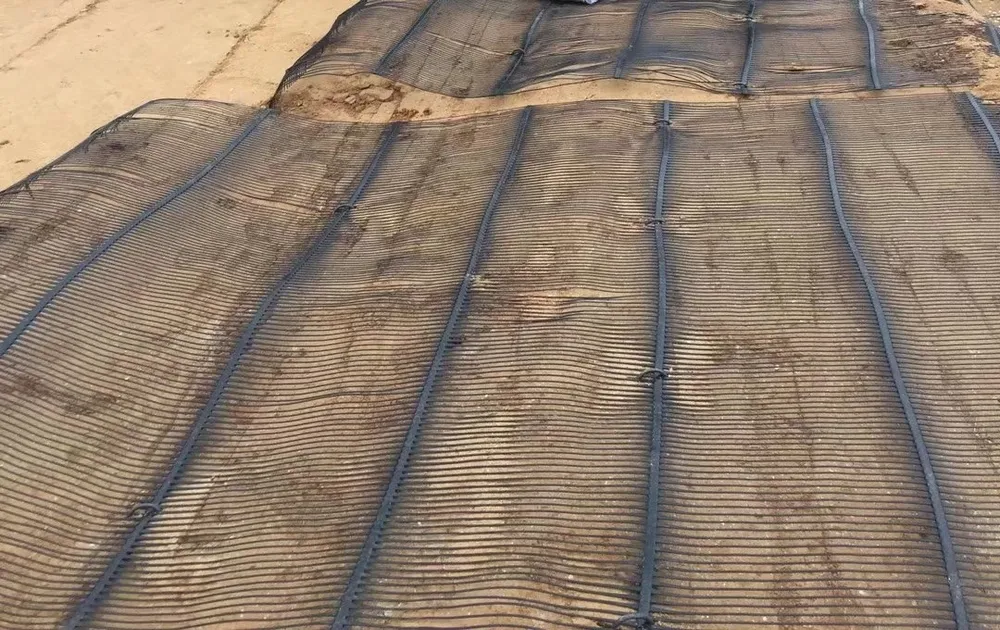
The uniaxial LTDS grades go into segmental and panel-faced retaining walls, bridge abutments and reinforced steep slopes, laid in horizontal layers with the strong direction running back into the fill. For geogrid slope stabilization the flexibility of a knitted PET grid is an advantage: it follows a cut face and wraps a slope lift without the memory of an extruded roll. Knitted biaxial grades spread load in both directions for working platforms and subgrade stabilization — the same job covered by biaxial geogrid and steel-plastic geogrid, and worth comparing on strength, stiffness and cost before you commit. Anyone searching geogrid for slopes should also size the drainage and the face treatment, not just the reinforcement.

Geogrid and geotextile together

On soft or fine-grained subgrades the grid is only half the system. A grid reinforces; a fabric separates and filters. Specifying geogrid and geotextile as a pair keeps fines from pumping into the granular layer while the grid takes the tension — pair a PET grid with a polyester filament nonwoven geotextile or a PET needle-punched geotextile for separation and filtration, or with a woven geotextile where the separator itself must carry load. Wall toes and scour zones often add a geobag. The full range of geogrid types and the geogrid material options behind them are listed on our products page — send the design LTDS, layer spacing and quantity and we will quote against it.

More views

Polyester Geogrid — More viewsPolyester Geogrid — More viewsPolyester Geogrid — More views

Manufacturing

Polyester Geogrid — Manufacturing

Shipping & packaging

Polyester Geogrid — Shipping & packaging

Key features

  • PET yarn bundles bound at every crossing — the junction is knitted, not welded
  • Published LTDS at a 120-year design life, not just a breaking strength
  • High tensile modulus: usable strength is already developed at 2% and 5% strain
  • Flexible grid conforms to a prepared subgrade and to wall block courses
  • PVC, SBR or bitumen coating chosen for the fill chemistry and installation
  • Uniaxial and biaxial knitted ladders, plus quote-on-request high-strength grades

Ideal for

  • Geogrid reinforced soil retaining walls and MSE walls
  • Reinforced steep slopes and geogrid slope stabilization
  • Bridge abutments and approach embankments over compressible ground
  • Basal reinforcement of embankments on soft or piled foundations
  • Working platforms, haul roads and subgrade stabilization
  • Landfill capping, veneer slopes and closure berms

Specifications

Polyester geogrid — uniaxial range, PVC coated, high-tenacity polyester yarn. Long-term design strength (LTDS) is quoted for a 120-year design life. Values verbatim from the source datasheet.

PropertyUnit60100200400800
Ultimate tensile strength (MD / CD)kN/m60 / 30100 / 30200 / 30400 / 50800 / 100
Tensile strength @ 2% strainkN/m12183668130
Tensile strength @ 5% strainkN/m3050100160270
Elongation at ultimate strength%1010101013
Long-term design strength (LTDS, 120 years)kN/m3460121236452
Mesh sizemm25 × 2525 × 2525 × 2525 × 2525 × 25
Roll widthm5.25.25.25.25.0
Roll lengthm1001001005050
Container loading (40HC)rolls / m²100 / 52,00090 / 46,80050 / 26,00060 / 15,60028 / 7,000
  • LTDS must be quoted with its design life (120 years). It is the ultimate strength after creep, installation-damage and ageing reduction — roughly 55–57% of ultimate across this range — and is not interchangeable with the ultimate tensile strength.
  • Knitted biaxial ladder (breaking strength only): 25-25, 30-30, 40-40, 50-50, 60-60, 80-80, 100-100 and 120-120 kN/m ≥, equal warp and weft; elongation at break ≤ 13%; mesh size 12–50 mm; roll width 1–6 m. Roll length not published — confirm per order.
  • Knitted uniaxial low-strength ladder (breaking strength only): warp 25, 30, 50, 80, 100 and 120 kN/m ≥ with weft 15 kN/m ≥ throughout; elongation at break ≤ 13%; mesh size 12–50 mm; roll width 1–6 m. Roll length not published — confirm per order.
  • High-strength uniaxial grades — 150–1000 kN/m warp / 30–50 kN/m weft, elongation ≤ 13%, mesh 25 × 25, 40 × 40 or 50 × 50 mm, width 1–6 m, oil- or water-based PVC coating — are published as a range only, with no per-model table. These are quote-on-request with a mill certificate rather than standard stock.

Frequently asked questions

What is a polyester geogrid made of?

High-tenacity polyester (PET) industrial filament. The yarn bundles are warp-knitted so they are bound at every crossing point, then the finished grid is coated with PVC, SBR or bitumen. The coating protects the filaments during installation; the load is carried by the straight PET bundles.

How do I use the LTDS figures in a wall design?

LTDS is the long-term design strength — the ultimate strength after reductions for creep, installation damage and ageing — and ours is published for a 120-year design life: 34, 60, 121, 236 and 452 kN/m for the 60, 100, 200, 400 and 800 grades. Use it as the available reinforcement strength per layer, then apply your own design factor of safety. Never substitute the ultimate tensile strength for LTDS, and never quote LTDS without stating the design life it belongs to.

Why is the LTDS so much lower than the breaking strength?

Because a reinforcement has to hold load for the life of the structure, not for the few minutes of a tensile test. Creep under sustained load, damage during placement and compaction, and long-term chemical and biological ageing all reduce what the grid can safely carry. Across this range the LTDS works out at roughly 55–57% of ultimate, which is normal for a coated PET grid.

PVC, SBR or bitumen coating — which should I specify?

PVC is the general-purpose choice and is what the uniaxial LTDS range is supplied with. SBR gives a softer, more flexible grid that handles better in cold weather or tight radii. Bitumen is for grids placed into or under bituminous layers, so the grid bonds rather than forming a slip plane. Send us the fill type, placement conditions and whether the grid meets asphalt and we will confirm.

How does a PET geogrid differ from fiberglass or plastic geogrid?

Fibreglass is very stiff but brittle, which suits asphalt interlayers rather than soil reinforcement. An extruded plastic grid is rigid and interlocks with aggregate, but needs more strain to mobilise the same force. A knitted PET grid is flexible, conforms to the subgrade and develops high strength at low strain, which is why it dominates high-load reinforced walls and slopes. Compare the ranges on our fiberglass geogrid, biaxial geogrid and uniaxial geogrid pages.

Do I need a geotextile as well as the geogrid?

On soft or fine-grained subgrades, yes. The grid reinforces; it does not separate. Without a separation layer, fines pump up into the granular fill and the layer loses strength. Pair the grid with a polyester filament nonwoven or PET needle-punched geotextile for separation and filtration, or with a woven geotextile where the separator itself must carry load.

What sizes and roll lengths are available?

The uniaxial PVC-coated LTDS range is 5.2 m wide on 100 m rolls for the 60, 100 and 200 grades, and 5.2 m / 5.0 m wide on 50 m rolls for the 400 and 800 grades, all with a 25 × 25 mm mesh. The knitted biaxial and low-strength uniaxial ladders are made 1–6 m wide with a 12–50 mm mesh; roll length for those is not published, so confirm it on the order.

Can you supply grades above 800 kN/m?

High-strength uniaxial is produced from 150 up to 1000 kN/m warp with 30–50 kN/m weft, elongation ≤ 13%, mesh 25 × 25, 40 × 40 or 50 × 50 mm and widths of 1–6 m, in oil- or water-based PVC coating. It is published as a range rather than a per-model table, so treat anything above the standard ladder as quote-on-request and ask for the mill certificate with the offer.

Request a quote for the Polyester Geogrid

Tell us quantity, destination port, and any questions — we reply within one business day.

Prefer to chat? Reach us instantly on WhatsApp:

Related products

PP Biaxial Geogrid Geogrid

PP Biaxial Geogrid

Punched and drawn PP biaxial geogrid for subgrade stabilization and base reinforcement — 15-15 to 50-50 kN/m grades, square apertures, 93% junction efficiency.

  • 15-15 → 50-50 kN/m
  • Polypropylene · Punched & drawn
  • Junction efficiency 93%
Get a quote →
Uniaxial Geogrid Geogrid

Uniaxial Geogrid

PP and HDPE uniaxial geogrid for retaining walls, MSE walls and reinforced slopes — 60–300 kN/m machine-direction strength, long oval apertures, low creep.

  • 60–300 kN/m
  • PP · HDPE uniaxial
  • ASTM D6637
Get a quote →
Fiberglass Geogrid Geogrid

Fiberglass Geogrid

Bitumen-coated fiberglass geogrid for asphalt overlays — warp-knitted alkali-free glass fibre, 25–120 kN/m, elongation ≤ 4%, standard and self-adhesive.

  • 25–120 kN/m
  • Elongation ≤ 4%
  • Standard & self-adhesive
Get a quote →