Sort them by function, not by looks
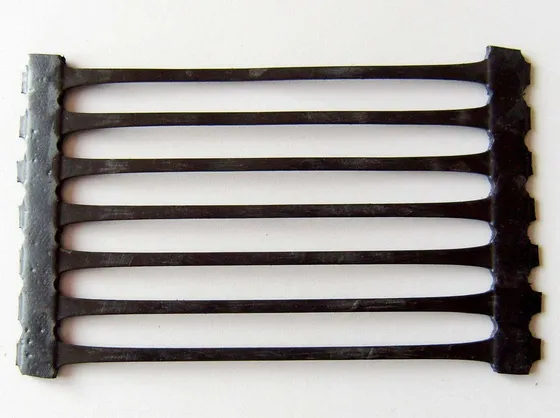
These four products get compared as if they were competing versions of the same thing. They are not — each one does a job the others cannot, and most real projects use two or three together. Geogrid reinforces: it takes tension a soil mass cannot. Geotextile separates and filters: it keeps two soil layers from mixing while letting water through. Geonet drains: it carries water sideways within the structure. Geocell confines: it holds material inside three-dimensional cells so it cannot spread. Decide what the layer must do and the choice usually makes itself.
Geogrid and geotextile: the pairing, not the contest
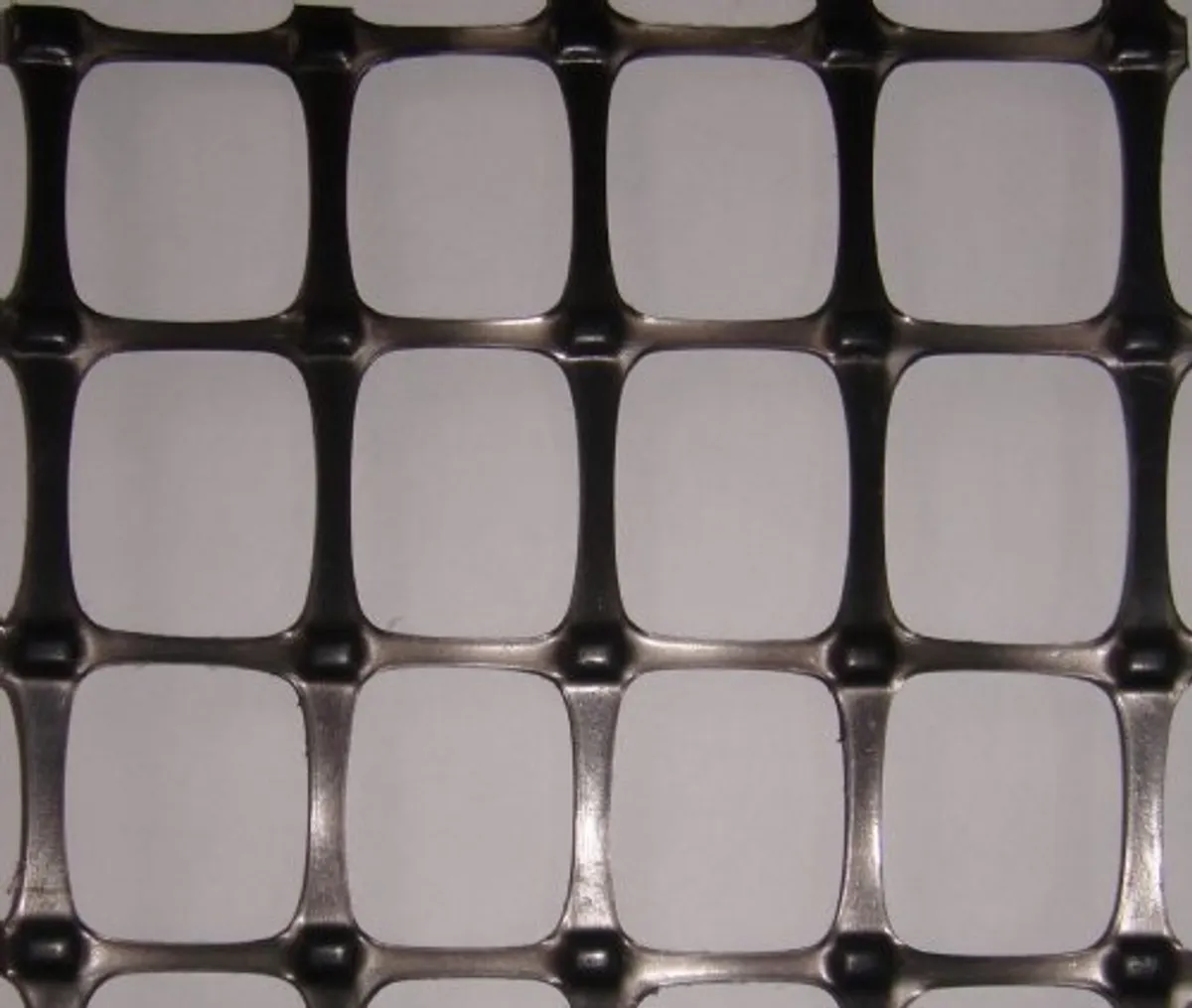
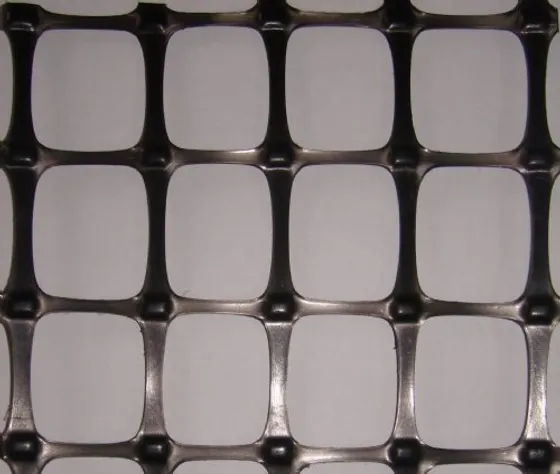
This is the comparison people search for most, and the answer is usually "both". A biaxial geogrid works by letting aggregate drop into its apertures and lock there, so the fill stops moving laterally and the layer stiffens. It cannot separate anything — its whole design is holes. A woven geotextile or nonwoven geotextile is a continuous fabric: it stops soft subgrade fines pumping up into the granular layer, filters water without losing soil, and cushions liners against puncture. Put a grid alone on soft clay and the base course slowly contaminates itself until the design strength is gone. The standard build is fabric on the subgrade for separation, grid above it for tension, aggregate over both. Woven geotextile adds tensile capacity of its own, which is why a light job sometimes uses it in place of a grid — but per kN of reinforcement, the grid is the cheaper and stiffer answer.
Geonet: the one that moves water
A geonet looks like a coarse geogrid and does something entirely unrelated. Its ribs cross at an angle to leave open channels in the plane of the sheet, so liquid or gas travels along the sheet rather than through it — landfill leachate collection, drainage behind a retaining wall, gas venting under a cap. Bond a nonwoven to each face and you have a geocomposite drain that filters and drains at once. Nobody designs a geonet as reinforcement, and no geogrid should be counted on for in-plane flow; the aperture geometry that interlocks aggregate is not a drainage channel.
Geocell: confinement in three dimensions
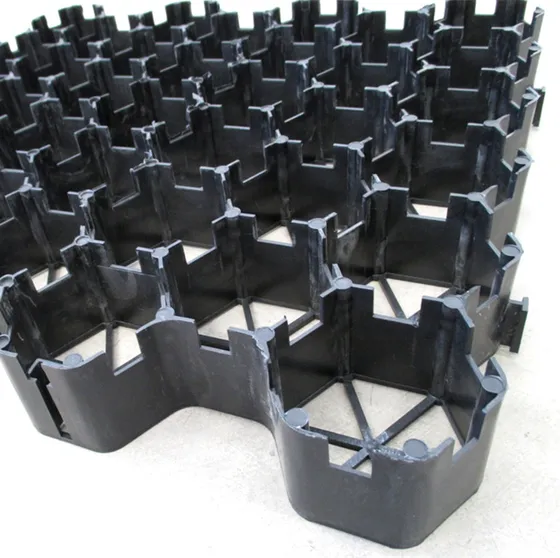
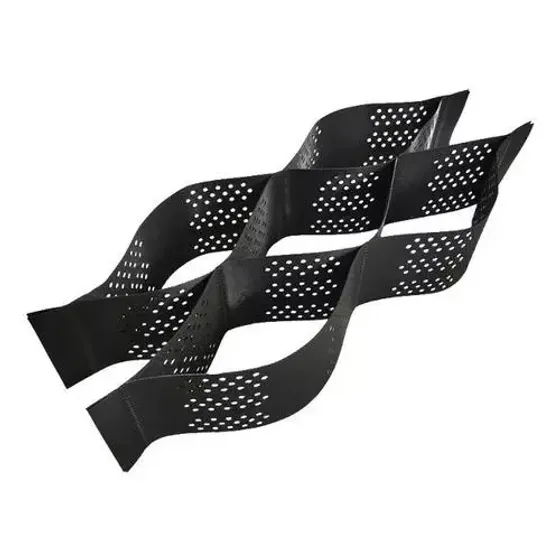
A geocell is the odd one out because it has depth. Strips of HDPE are welded into a honeycomb that expands on site into cells 50 to 200 mm deep and filled with soil, sand, gravel or concrete, so the fill is wrapped on all sides instead of interlocked in one plane. That makes a geocell the better answer where the fill is poor or rounded and where the layer surface itself has to stay put, while a grid is more economical under traffic with good angular aggregate. We have written that comparison out in full — see geocell vs geogrid if that is the decision in front of you.
The "geo grid driveway" mix-up worth clearing up
Two different products share a name in everyday North American usage, and it costs buyers money. Search geo grid driveway, gravel geogrid, geogrid ground grid or honeycomb geogrid and most of the results are cellular panels — the honeycomb or diamond-cell trays laid on a prepared base, filled with gravel or planted with grass, that keep a driveway or parking area from rutting and migrating. Those are gravel grid panels or HDPE geocell, and for a residential drive, a grass overflow bay or a garden path they are almost always what the job wants. A structural geogrid is a flat mesh with no depth; it goes under the base course to reinforce it, and laid at the surface it does nothing to stop loose gravel wandering. The two are complementary rather than rival: on a soft-ground driveway you may well want a geogrid down at the subgrade and a gravel grid at the top, each doing its own job.
Where each one belongs
- Reinforce a base or subgrade under traffic → biaxial geogrid, with a separation fabric below on soft ground.
- Hold back earth behind a wall or steep slope → uniaxial geogrid in horizontal layers to the wall designer's spacing.
- Stop two soil layers mixing, or filter water out of soil → woven or nonwoven geotextile.
- Collect and carry water within the structure → geonet, or a geonet geocomposite with bonded fabric.
- Keep gravel, sand or topsoil from spreading — driveways, slopes, poor fill → gravel grid panels or HDPE geocell, depth chosen for the load.
Tell us the problem, not the product name
Half the enquiries we answer name a product that is not the one the site needs, usually because the terminology overlaps. Describe the subgrade, the load, the fill you can get locally and what is going wrong or being built, and we will say which of these four applies — including when the honest answer is that you need two of them, or that the cheapest one is enough. Everything above ships from the same range: see the full geosynthetics catalogue for grades, roll sizes and container loading.
Free Geosynthetics Spec & Selection Guide
Material grades, thickness/GSM sizing and price ranges for your project — sent to your inbox.

 Geogrid