
Geocell ground stabilization: road base, slope erosion control and grass parking
How geocell (cellular confinement) stabilizes a soft road base, holds fill on a slope and turns a parking area into grass pavers.
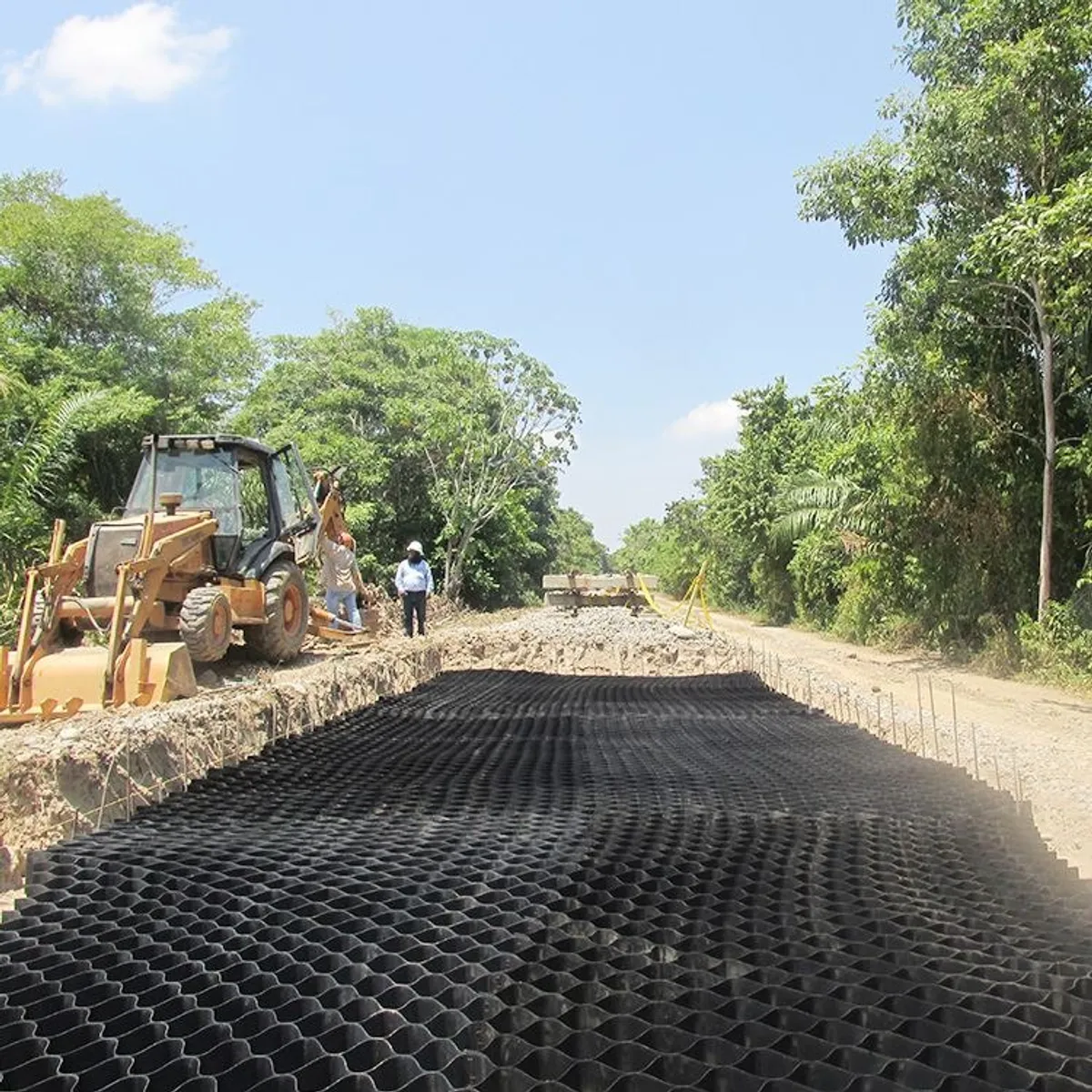
What geocell actually does
A geocell is a honeycomb of welded HDPE strips that expands on site into a panel of cells, which you fill with soil, sand or aggregate. The cell walls grip the fill and stop it spreading sideways under load — that lateral confinement is the whole trick. Confined gravel behaves more like a semi-rigid slab than a loose layer, so a thin geocell mattress carries traffic that would rut and pump straight through the same depth of unconfined stone. People call it a cellular confinement system, a gravel grid or geoweb; it's the same idea — turn loose fill into a stiff, load-spreading mat.
Geocell road base over soft ground
On weak subgrade a geocell road base earns its keep. Lay the panels over a separation geotextile, stretch them taut, peg them, and fill with granular material. The confined layer spreads wheel loads over a wider footprint, cuts the rutting and lets you build a working platform with far less imported aggregate than an unconfined section needs — often a third to a half less stone for the same bearing. The failure mode is almost always the same: panels filled before they were fully expanded and tensioned, so the cells sit slack and the load punches a single cell instead of mobilising the whole mat. Stretch them out properly and stake the perimeter before a single bucket of fill goes in. On very soft clay, pair the geocell with the deeper drainage work — it stabilises the surface, it doesn't consolidate the subsoil.
Geocell for slope stabilization and erosion control
On a slope the enemy is gravity and running water, and an unconfined topsoil or gravel face sheds both. Geocell erosion control anchors the fill in the cells so it can't slide or wash off — water runs over a stabilised surface instead of cutting rills into bare soil. For a vegetated finish use a textured perforated geocell: the perforations let roots and water cross between cells and the textured walls raise the friction against the fill, which matters on anything steeper than about 1:2. Anchor the top of the panel in a crest trench and tendon or stake it down the face — a geocell for slope stabilization that isn't anchored at the crest just slides as one mat in the first heavy rain. On gentler banks a smoother cell does fine; where the slope is shallow and the load light, a smooth HDPE geocell is the cheaper call.
Grass pavers for parking and access
The same confinement makes a load-bearing green surface. Fill the cells with topsoil and seed, or with gravel, and you get grass pavers for parking, overflow car parks, fire-access lanes and driveways that stay green but carry a vehicle without rutting. The cell walls take the wheel load so the root zone underneath isn't crushed, and water infiltrates instead of running off — useful where a paved lot would need a drainage budget of its own. A shallow gravel grid panel is the usual product here; for a grassed finish the perforated geocell lets the roots knit across cells. Don't skimp on the bedding course — pavers laid straight on uneven subgrade settle unevenly no matter how good the cell is.
Filling, depth and the level checks
Three numbers set the job: cell depth, cell size and infill. Deeper cells (150–200 mm) carry heavier traffic; shallow cells (75–100 mm) suit grass parking and light access. Match infill to the duty — angular crushed stone for road base and steep slopes, topsoil for vegetation. Overfill each cell slightly and compact so the fill locks against the walls; an underfilled cell lets the aggregate move and you lose the confinement you paid for. Check the surface level as you fill, not after — a geocell mat that's gone wavy because the subgrade wasn't graded first is a lot of work to lift and redo.
Spec it to the load and the slope
Tell us the application, the design traffic or slope angle, and whether you want a vegetated or gravel finish, and we'll call the cell depth and surface and ship matched panels with tendons and stakes. For a road base or steep erosion face, start with the textured perforated geocell; for grass parking and light access, the gravel grid is usually the right depth and price.
Free Geosynthetics Spec & Selection Guide
Material grades, thickness/GSM sizing and price ranges for your project — sent to your inbox.
Frequently asked questions
What does a geocell do for a road base?
It confines the granular fill so it can't spread under wheel loads, turning a loose stone layer into a stiff load-spreading mat. That lets a thinner section carry the same traffic and cuts the imported aggregate by roughly a third to a half over an unconfined base.
Does geocell stop slope erosion?
Yes — the cells hold the topsoil or gravel in place so water runs over a stabilised surface instead of cutting rills. It only works if the panel is anchored in a crest trench and staked down the face; an unanchored mat slides as one piece.
Can you park cars on a grass geocell?
Yes. Filled with topsoil and seeded, a geocell grass paver carries car and light-truck loads while staying green, because the cell walls take the wheel load off the root zone. Use a deeper cell and gravel infill for heavier or constant traffic.
What infill goes in a geocell?
Angular crushed stone for road base and steep slopes, topsoil for vegetated finishes, gravel for parking and drainage. Match the infill to the duty and compact it slightly proud so it locks against the cell walls.
Related product
View Textured Perforated HDPE GeocellNeed a quote or a spec check?
Tell us your application and quantity — our English-speaking team replies within one business day.